
Slopppp
the woke liberal media triggered me again

Quick post today - don’t forget to subscribe to my other weekly newsletter, Secret Ballot which is now live and filled with all sorts of DC secrets.

The play I saw recently at DC’s Shakespeare Theatre Company - an adaptation of Merry Wives set in a community of West African immigrants in Harlem - was so egregious in its execution I had to look away. I am not heartless. I enjoy slop all the time and can even make some small allowances - plays take years to produce and I’m sure it must have started going into development at peak woke. But actually, no, it’s 2025. There really is no excuse.
To be fair, I had a good time. The Christian immigrant community was a fitting setting for the story, the cast was talented and expressive, and Shakespeare remains an eternal joy. But none of that redeems the shoehorned queer subplot that got neatly tied up in the end (“Despite many distracting hijinks, my initially judgmental Christian Ghanian father suddenly welcomed my lesbian lover with open arms by Act III”). This is not the same as honest engagement with the tensions that exist around authority, sexuality, and faith in conservative communities. It is a cliche of a cliche at this point, and eternally condescending to paste over these complexities with the paper-thin saccharine reconciliation that grants neither character nor community the dignity of struggle.
Shakespeare’s genius lies in his ability to wound us with truths about our own human nature and then heal us with cathartic laughter about the very same. That genius of universality is brought into stark relief when it is juxtaposed with the ham-fisted, ephemeral moral signaling of the recent past. In the case of this play, it felt annoyingly tacked on, like a sticky note on the Mona Lisa. I suppressed my groans as I clapped along with the mostly white-haired audience, wondering if they sincerely enjoyed this kind of thing, if it made them feel better, or if they, too, recognized it for the slop it was.
I can’t speak for West African Christianity, but I can speak to the realities of the highly conservative Christian community I grew up in. I know that refusing to engage with religious conviction or to take the norms and struggles of these communities seriously on their own terms, is to deny them the dignity of equality. Sanding away those conflicts in an effort to hold all truths as equal is to treat adults as children who are incapable of holding complexity, and speaks to a cowardice of spirit and an impoverished imagination. It reminds me of the hokey little kids TV shows they used to show at my private Christian kindergarten where everyone learns their neat little Bible lesson in the end. God told Abraham to sacrifice Isaac. God sacrificed His own Son. You think I can’t handle the truth? Insulting.
I see this all the time - in friendship, in art, in criticism… a desire to hurry past tension, to paper over struggle and sink into ease. Some of the brightest people I know are willing to endlessly engage with “nuance,” circling and naming it and sometimes approaching it as if they might finally sink their teeth into it and rip it up… but rarely am I satisfied. More often than not I see nothing more than petty fear, a lack of willingness to sink into the deep discomfort and humility of treating their opponents with the dignity of full personhood, or of granting them the honor of their convictions. Grappling with tension looks and feels a lot different than flattening it. Grappling with people - homophobes, evangelicals, libs, and all the rest - as they are and not as you wish them to be is a lot more difficult than drawing them up as little paper dolls and making them kiss and sing kumbaya. A paper doll does not struggle. A paper doll has no dignity.
In my efforts to be more constructive and less whiny, here are some examples off the top of my head of what actual engagement would look like in art (and maybe also in life):
Letting conflict breathe - What happens when people stay divided? What becomes visible? What builds? Visible fractures reflect reality as it is, not as we wish it was.
Granting convictions weight - This means taking the other side (whatever side that may be) seriously and not waving their convictions away as ignorance that needs to be rehabilitated, or bigotry that implies an irreparable rot. No strawmen.
Showing the cost - What happens when tensions remain unresolved? Who suffers and why? What is the cost of cheap, unearned healing? The stakes?
Staying implicated - Let he who has not sinned cast the first stone
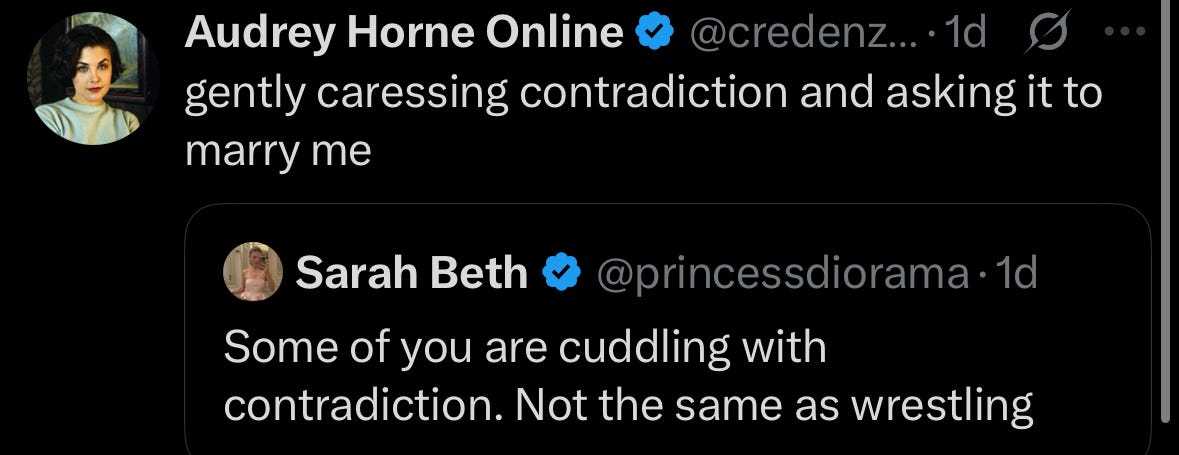
The hardest work of all is to endure. To stay inside the mess. True healing comes from digging into the wound and pulling out the shrapnel and the poison and all the mess inside before putting a band-aid on it. As Sarah Beth Spraggins and I were discussing last week, some of y’all are cuddling with contradiction instead of fighting it tooth and nail.
1. Not quite the same, but I remember seeing Heroes of the Fourth Turning a few years ago in LA, and the (generically progressive millennial / gen z) audience consistently laughed in the wrong spots. It was like they couldn’t compute that the characters had sincerely held beliefs that didn’t jive with their worldview, even as the characters gave substantive reasoning for those views. I’m mostly a generic lib, but from a v conservative religious background with people I love in HotFT cultural spaces. I found the experience really bone chilling.
2. Eureka Day, a play about a progressive Berkeley day school negotiating vaccination policy, is one of the few in recent memory that comes down strongly on one side but felt genuine in how it let characters breathe and act like real human beings. It helps that it was written pre-pandemic and handles a now right-coded issue in a left wing space
This strikes a chord, one strung by my Yankee forebears and my deeply religious and generous great grandmother